The Philippines needs a more independent Commission on Higher Education (CHED) and a regulatory framework that promotes fair competition between public and private higher education institutions (HEIs), Dr. Michael M. Alba, president of the Far Eastern University Public Policy Center (FEU PPC), said at a forum titled "Ready for Work? Rethinking Education, Skills, and the Philippine Labor Market."
Alba said the country must examine how higher education is governed to ensure that investments in education translate into a workforce equipped to respond to changing economic and technological demands.
"If you are to maximize the Philippines' demographic dividend by developing a globally competitive workforce equipped to navigate the technological and other disruptions of the 21st century, we need to begin by exploring the institutional architecture of education provision," Alba said.
"Institutions are the deep determinants of economic growth," he added.
In his presentation, "Rethinking the Regulation of Philippine Higher Education: Market and Government Failures, Regulatory Independence, and Competitive Neutrality," Alba argued that neither market forces nor direct provision alone can ensure the desired outcomes in higher education.
He cited information gaps between schools and students as one example of market failure, noting that students may lack sufficient information to assess the quality and labor-market value of the education they receive.
Alba also pointed to government policies and institutional arrangements that, in his view, may constrain HEIs’ ability to respond to changing needs.
Alba’s analysis drew on an FEU PPC research project on the economic regulation of Philippine higher education, jointly funded through the UP President Edgardo J. Angara Fellowship Grant and FEU.
Three weaknesses in higher education regulation
Examining the legal foundations of CHED, including the 1987 Constitution, Batas Pambansa Blg. 232, Republic Act Nos. 7722 and 8292, Alba identified three weaknesses in the existing regulatory framework: insufficient regulatory independence, excessive room for discretionary decision-making, and inadequate competitive neutrality.
He argued that CHED needs greater independence to maintain a credible and stable regulatory regime. He also called for clearer, rule-based processes to limit arbitrary decisions and promote consistency in the application of regulations.
Competitive neutrality, meanwhile, ensures that public and private institutions compete under fair and transparent conditions, without undue advantages arising from the government’s role as both education provider and regulator.
"Competitive neutrality requires a very clear separation of powers and missions between government as service provider and industry regulator," Alba said.
His proposed reforms include explicit safeguards to ensure that CHED commissioners can be dismissed only for cause; ethical standards for CHED personnel; and restrictions on commissioners, legislators, executive officials, and military officers serving on the governing boards of state universities and colleges.
Alba also called for regular reporting to stakeholders, a more sophisticated higher-education information system, and stronger institutional expertise in regulation, higher-education policy, and data science.
He proposed a common regulatory framework and uniform disclosure requirements for HEIs, while recognizing the need to account for differences in institutional mandates.
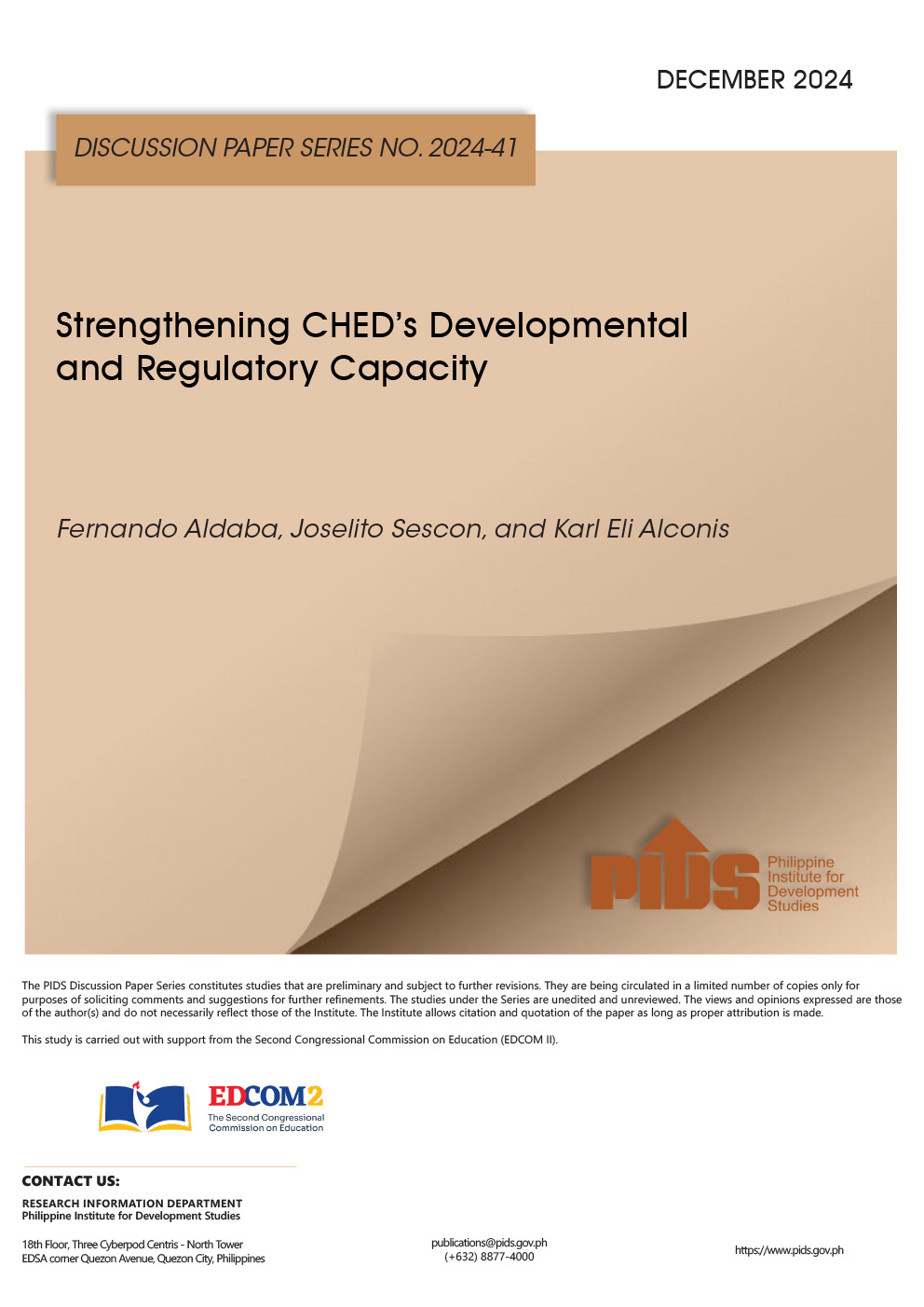
Alba’s analysis addresses issues also examined in the 2024 PIDS Discussion Paper, Strengthening CHED’s Developmental and Regulatory Capacity, by Fernando Aldaba, Joselito Sescon, and Karl Eli Alconis.
The study reviewed CHED’s mandate, compared higher education systems in Southeast Asia, and interviewed representatives of the Commission and HEIs.
It identified challenges, including CHED’s disproportionate focus on regulation rather than on institutional development, limited support for faculty capacity building and research, and misalignment between higher education curricula and labor market needs.
The study recommended clearer delineation of CHED’s regulatory and developmental functions, stronger quality assurance, and closer partnerships between higher education institutions and industry. It also advocated fair treatment of public and private institutions, including consideration of financial assistance for students enrolled in accredited private institutions.
Education must translate into productive work
The forum also examined whether education and skills development are translating into better employment opportunities and stronger productivity.
PIDS Senior ²ÝÝ®ÊÓƵ Fellow Dr. Michael Ralph M. Abrigo said having educated and skilled Filipinos does not automatically lead to higher productivity or better jobs if institutions and labor markets fail to provide opportunities to use their capabilities.
“The more interesting question is, are we creating the conditions in which people can actually use what they have learned, the skills that they have gained?” Abrigo said. He raised questions about whether students acquire the skills needed in the labor market, whether workers can find jobs that use their capabilities, and whether firms can find the people they need.
Dr. Alexis Antoniades, former professor at Georgetown University in Qatar, discussed how artificial intelligence could affect employment in service-exporting economies such as the Philippines, particularly workers in the business process outsourcing sector.
Hanibal Camua, executive director of Philippine Business for Education, said skills gaps in the information technology and business process outsourcing sector already constrain employers’ ability to fill positions, even before the full effects of AI are taken into account.
FEU PPC Trustee Atty. Gianna R. Montinola said technological change is transforming industries and occupations while employers’ skills requirements continue to evolve.
The public forum was held in partnership with the ²ÝÝ®ÊÓƵ as part of the 24th Development Policy ²ÝÝ®ÊÓƵ Month (DPRM).
The 2026 DPRM theme, “Building Strong Institutions, Unlocking Human Capital Potential,” highlights the role of institutions in ensuring that investments in people translate into productive, inclusive, and resilient livelihoods.
Read more about the FEU PPC study through SERP-P: . ### — NMT