The Philippines embraced a devolution agenda in 1991 through the enactment of the Local Government Code (LGC). More than three decades since its implementation, devolution remains incomplete, resulting in ambiguous lines of accountability between the national government and local government units (LGUs), as well as inefficiencies in the delivery of basic devolved services. In March 2023, President Ferdinand Marcos Jr. ordered a review of the functions, services, and facilities that will be fully devolved to LGUs.
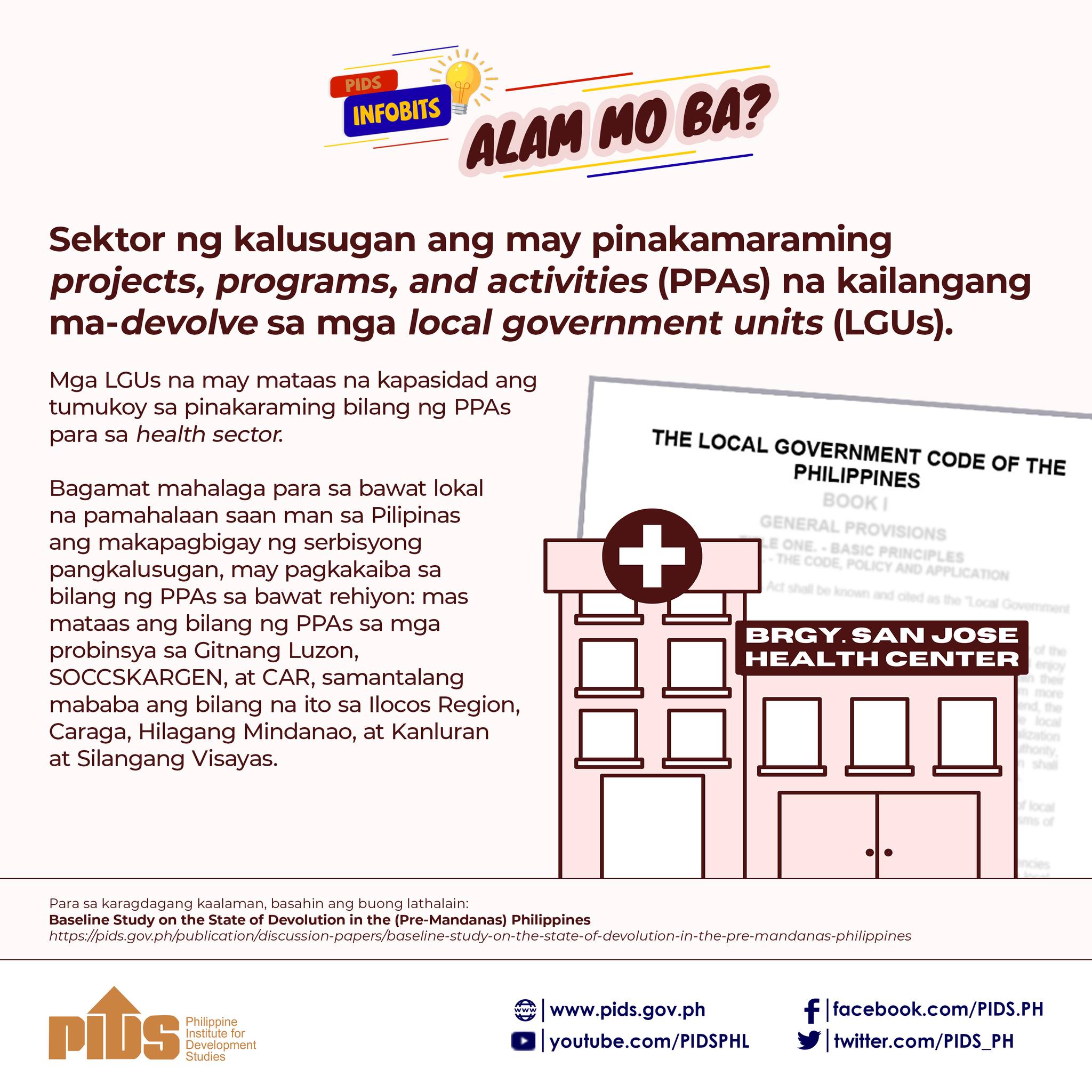
In response to the call for review, this study assessed LGU functional assignments across three critical sectors—health, infrastructure, and agriculture. It “unbundled” the broad functions identified in the LGC and examined them in relation to the principles guiding functional assignment. It also discussed the binding constraints on full devolution in the country. An expenditure analysis was conducted to determine whether the increase in available financing during the first year of implementation of the Mandanas-Garcia Supreme Court ruling translated into improved service delivery of devolved functions, as reflected in LGU spending.
The study found that the country’s emphasis on subsidiarity and local autonomy, coupled with binding constraints, resulted in large gaps between de jure and de facto functional assignments, and variations in the devolved functions assumed by LGUs. Data further indicated uneven uptake or utilization of the increased funding across LGU levels. The study called for a reevaluation of the functional assignments and the development of a strategy to address these binding constraints on devolution: fiscal imbalances, weak institutional capacity, poor enforcement, and political economy factors. In particular, the study recommended ways to reassign devolved functions—between national and local governments and among different levels of LGUs—while accounting for institutional constraints and interjurisdictional spillovers.