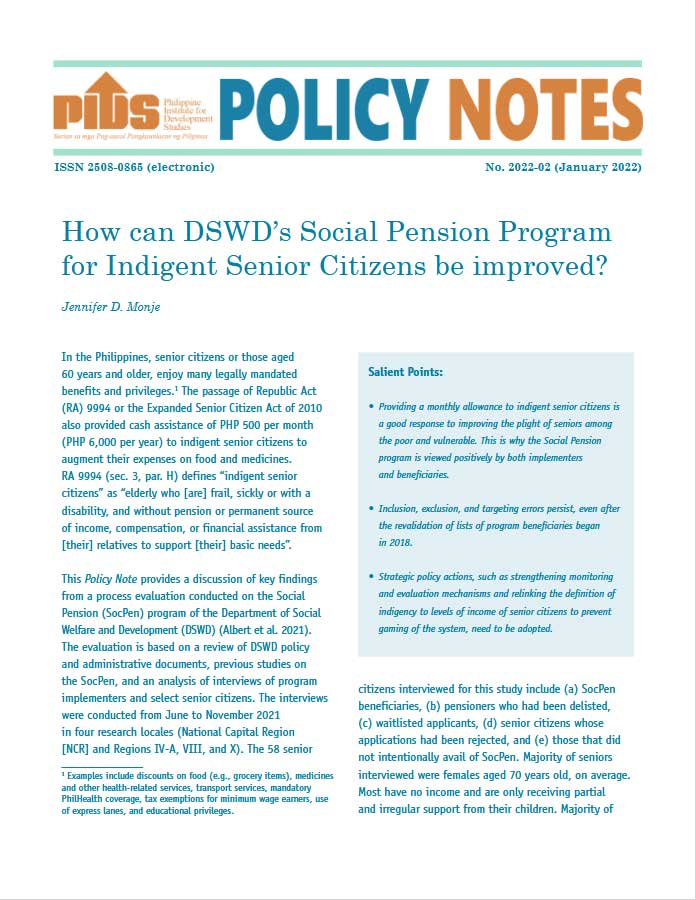
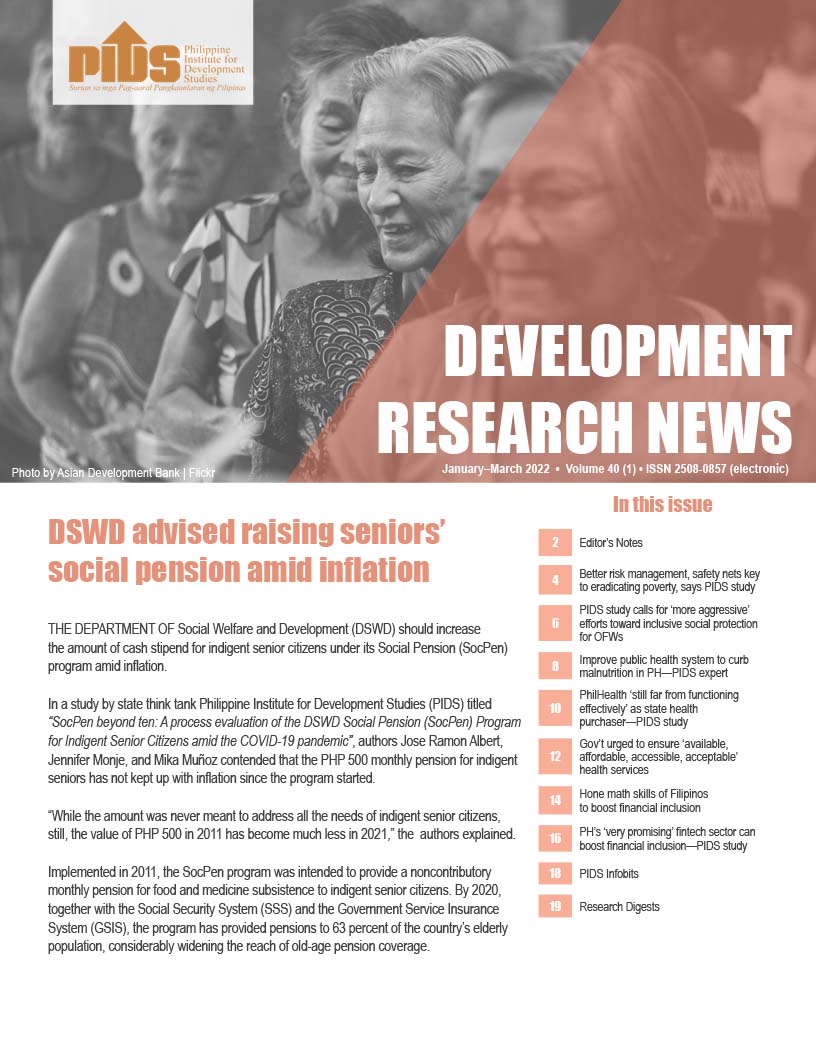
Many older Filipinos who are not officially classified as poor remain economically vulnerable. This suggests that poverty rates alone may fail to identify many seniors who could benefit from social protection programs, according to studies presented during the recent ‘Inclusive Social Protection Services in the Philippines’ Policy and 草莓视频 Forum. The forum was organised by the 草莓视频 (PIDS) and Australia’s flagship Social Protection, Inclusion, and Gender Equality (SPRING) program in the Philippines.
Presenting a study on household vulnerability to income poverty, PIDS Supervising 草莓视频 Specialist Deanne Lorraine Cabalfin said poverty statistics alone are insufficient for identifying older persons at economic risk.
The study found that while only 7.8% of senior citizens were classified as poor in 2023, 24% were vulnerable to falling into poverty. The official poverty threshold measures whether households can afford a minimum basket of food and non-food needs at a given point in time. However, it does not reflect the likelihood that households just above the threshold may slip into poverty due to economic or health-related shocks.
For older Filipinos, whose incomes are often fixed and whose healthcare needs tend to increase with age, vulnerability can therefore provide a more comprehensive picture of economic insecurity than poverty status alone.
The risk was even higher among seniors living in mixed-generation households, particularly those with children, where vulnerability reached nearly 45% despite relatively low poverty rates.
Cabalfin highlighted significant differences in how older people experience economic vulnerability. Older women living alone rely heavily on remittances for income, while older men living alone are the most asset-poor. Older households also spend a larger share of their income on food and healthcare, leaving many economically fragile despite not being classified as poor.
Women are particularly vulnerable, often reaching old age with fewer savings and weaker pension coverage. Disability, social isolation, and Indigenous identity can further compound these disadvantages.
"Kailangan nating regular na sukatin ang vulnerability, kasama ng poverty, para tugma ang program targeting sa tunay na risk (We need to regularly measure vulnerability alongside poverty so that the program targeting reflects the real risks people face)," Cabalfin said.
Based on the findings, Cabalfin called for a fiscally sustainable expansion of social pensions and the regular measurement of vulnerability alongside poverty to better target social protection programs.
SPRING Program Social Protection Specialist Aura Sevilla noted that 42% of Filipinos aged 60 and above have no pension, while nearly one-third of SSS pensioners receive less than PHP3,000 a month. The government’s social pension provides only PHP1,000 monthly and faces targeting challenges, with some eligible seniors excluded and some non-indigent beneficiaries included.
Meanwhile, Australian Embassy Second Secretary Claire Bowyer underscored the importance of designing social protection systems that respond to evolving risks.
“The question is no longer whether social protection matters. The question is how we can make it more responsive, more inclusive, and better equipped to support people through change and uncertainty,” she said.
Echoing this, PIDS President Dr. Philip Arnold P. Tuaño said research should not stop at identifying problems but should guide reforms that improve people’s lives.
“草莓视频 achieves its greatest value when it improves people’s lives,” Tuaño said, noting that evidence must translate into policies that build resilience, expand opportunities, and enable Filipinos to participate fully in economic and social life.
Department of Economy, Planning, and Development Director IV Girlie Grace Casimiro-Igtiben highlighted significant social protection reforms, including the Social Protection Operational Framework, the Social Protection Floor, digital payments for 4Ps beneficiaries, and the national ID rollout. She noted that while challenges remain, these initiatives are helping make social protection more integrated, responsive, and accessible.
Australia has worked with the Philippines to advance social protection for over two decades. The SPRING program is Australia’s flagship investment in the Philippines on social protection, gender equality, disability, and Indigenous inclusion. A five-year partnership between the Australian and Philippine Governments, SPRING supports close collaboration to strengthen national policies and systems on social protection; enhance gender budgeting, mainstreaming, and planning systems; and improve data to better reach vulnerable groups, such as people with disabilities and Indigenous Peoples. ###