Publicly funded agricultural and food technologies continue to face significant barriers to commercialization, with limited institutional capacity, lengthy approval processes, and inadequate support for scaling up innovations constraining their potential to generate economic returns, according to a study presented at a webinar organized by the ²ÝÝ®ÊÓƵ (PIDS).
The study, "," assessed the implementation of Republic Act No. 10055, or the Philippine Technology Transfer Act of 2009, which governs the ownership, management, and transfer of intellectual property arising from publicly funded research and development (R&D).
PIDS Senior ²ÝÝ®ÊÓƵ Fellow Roehlano Briones and Project Technical Specialist Helena Luz Pastolero compiled an inventory of 1,340 publicly funded agri-food technologies from 51 government offices and surveyed 34 research and development institutions and 56 private enterprises that had received or adopted these technologies.
Despite a 71% increase in intellectual property registrations over the past five years, the study found that generating commercial returns from publicly funded innovations remains a challenge.
Of the 1,340 technologies in the inventory, total royalties earned from 2021 to 2025 amounted to Php 23.5 million, or less than Php 18,000 per technology on average.
The study identified inadequate staffing and funding for technology licensing offices as key constraints. Of the 34 research and development institutions surveyed, 26 had dedicated technology licensing offices, with an average of three staff members and an annual budget of Php 500,000.
Securing intellectual property protection also takes time: patent applications take almost four years from application to approval, while utility models take about one year.
The study further found that only 15 of 32 institutions prioritized research based on in-house market studies or technology-readiness assessments.
“Funding for commercialization is just as important,” Pastolero said, emphasizing that bringing innovations to market also requires investment in “human capital, and most of all, time.”
Beyond research grants, institutions need adequate personnel, technical assistance, and support to prepare technologies for commercial use.
The difficulties continue even when businesses seek to adopt these innovations.
Mario Labadan Jr., president of AgriSpecialist Inc., highlighted this challenge from the perspective of businesses adopting publicly funded innovations.
“It is not ready for commercialization. It is ready for laboratory, but in reality, [it is] far from the commercial stage,” he said.
Briones gave a direct assessment of the Philippine Technology Transfer Act’s effectiveness in commercializing publicly funded agri-food research: “No, it was not successful.”
He attributed the shortcomings to underinvestment in technology transfer, fragmented programs, and insufficient support for scaling up research outputs.
Briones also pointed to regulatory and intellectual property registration requirements that can delay agreements between research institutions and businesses.
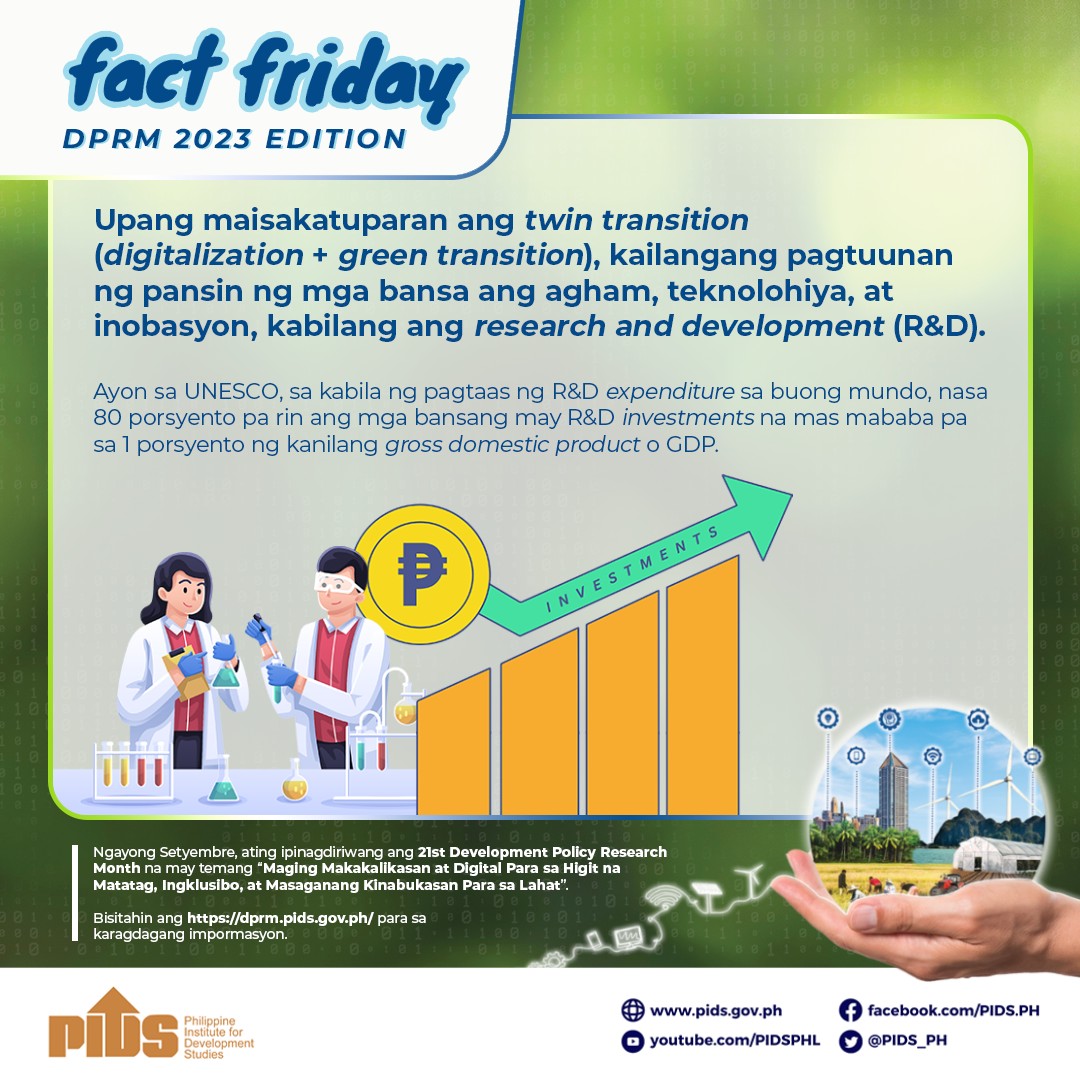
The study recommended increasing public R&D investment toward the 1% benchmark under the Agriculture and Fisheries Modernization Act, while improving the allocation of funds for personnel and capital outlay.
It also called for stronger public-private research collaboration, including the institutionalization of Regional ²ÝÝ®ÊÓƵ, Development, and Innovation Committees, and for reforms to the technology transfer process.
Proposed measures include establishing national or regional licensing centers, streamlining regulatory and intellectual property registration systems, and amending existing laws to address licensing restrictions and incentives for public-sector researchers.
The findings underscore the need to evaluate publicly funded research not only by the number of technologies developed or intellectual property registrations secured, but also by whether innovations reach users, attract investment, and generate sustained economic and social benefits.
Read the full study at . Watch the webinar playback at . ### — MJCG